
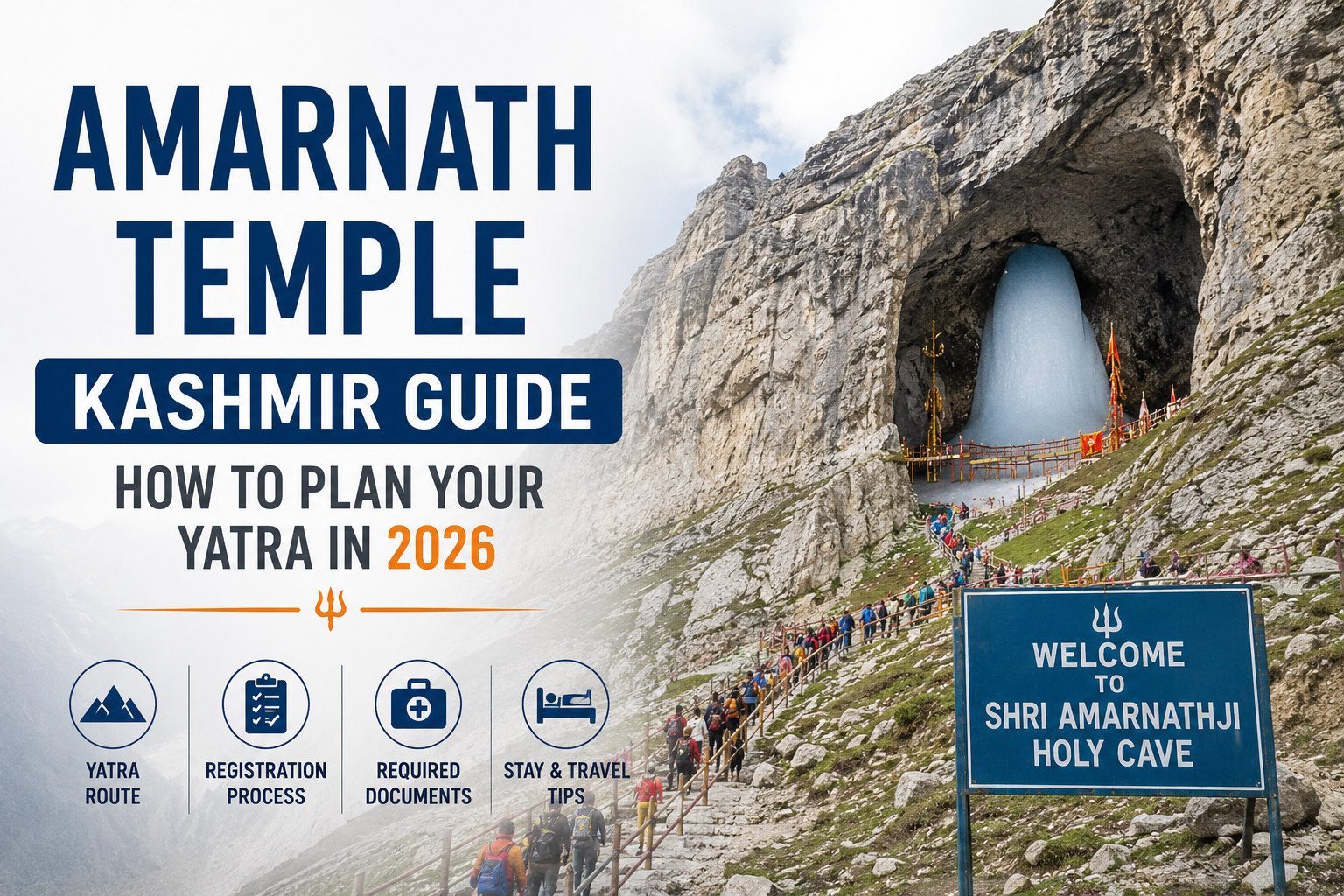
The Amarnath Temple in Kashmir can be a spiritual journey or logistical nightmare, depending on whether you have the right information to plan it. The Amarnath Temple is located at an elevation of 3,888 meters above sea level in the upper Himalayas, and the environment there is unforgiving of poor preparation. Routes closed without notice. Amarnath Yatra 2026 registration fills up quickly online Altitude sickness is for those who think they are fit enough to skip acclimatization.
The Shri Amarnathji Yatra 2026 will be held from July 3rd to August 28th, and advance registration is open from July 3rd to August 12th, 2026—which means the window to secure your spot is closing faster than many pilgrims realize.
If you’re considering going, this guide walks you through each step—registration, route choices, gear, and what to realistically expect on the ground. If you are also on a hike to the valley around your yatra, then here are some Kashmir tour packages to plan the entire trip.
What Is the Amarnath Temple and Why Do Pilgrims Visit?
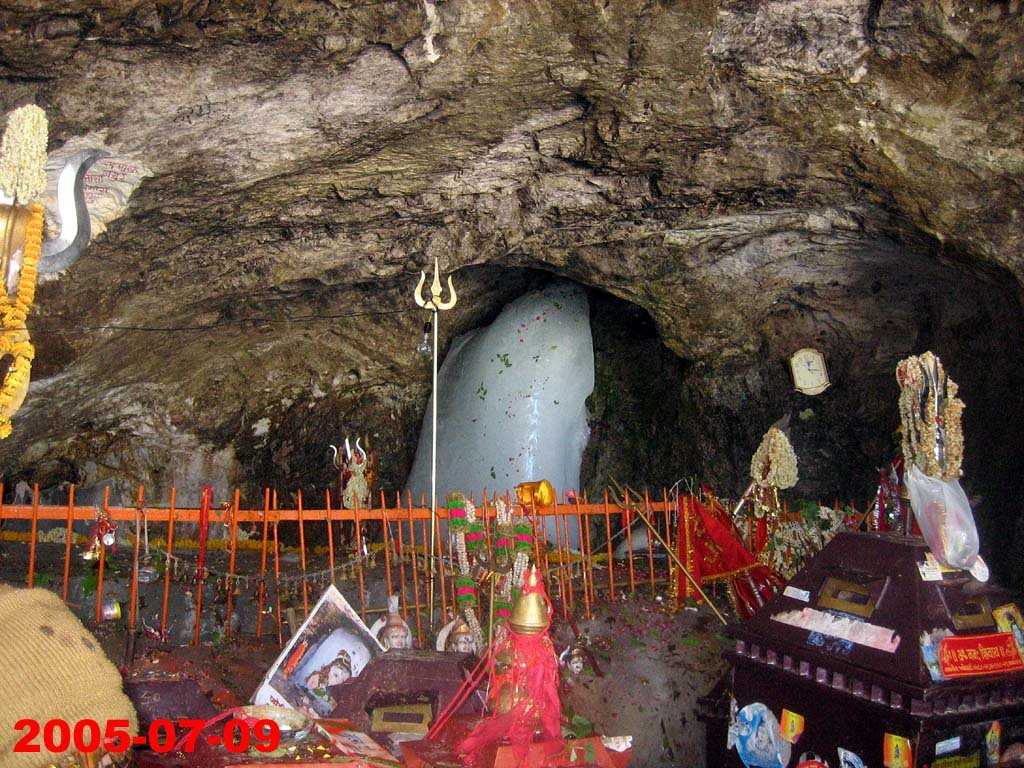
The Holiest Shrine of Hinduism—Amarnath Temple, Kashmir—is located in the upper Lidder Valley of Jammu and Kashmir. An ice Shivalinga naturally forms inside the cave, which is believed to be an emblem of Lord Shiva by the devotees. The water from the roof of the cave gets frozen in the cold and slowly makes the lingam in each season. This has been going on for centuries.
The cave is a large natural limestone cavern, some 75 feet high & extending about 80 feet into the mountain. It's cold. It's confined. And it's awe-inspiring. Two smaller ice formations, thought to be representations of Parvati and Ganesha, also naturally occur within the cave, beside the main lingam. Most first-time visitors are surprised by that.
Amarnath Yatra is not only a trek. It is mostly done by pilgrims as a personal act of devotion. The physical difficulty is part of the offering
Amarnath Yatra Registration: How to Secure Your Permit
Amarnath yatra registration is mandatory and can’t be negotiated. You will not be permitted beyond the base camps at Pahalgam or Baltal without a valid permit. The Shri Amarnathji Shrine Board (SASB) is doing all the registrations on jksasb.nic.in.
1. First, pick your route. Pahalgam or Baltal. Be sure to check actual availability dates before you book. Once you know when you want to go, fill in the basic details like name, gender, date of birth, Aadhaar number, state, district, and address. Add a mobile number and an emergency contact
2. Then you need your medical certificate. It has to be an SASB-approved hospital. Upload that as a PDF (file size less than 1 MB) and a passport picture as a JPG.
3. Provide the details of the hospital where you have been provided the medical certificate.
Tips
Make sure all documents are prepared before starting. If you close the form midway, it will not be saved.
Offline registration can also be done at selected Jammu and Kashmir Bank branches and other partner banks like Punjab National Bank (PNB), State Bank of India (SBI), and Yes Bank across India. If you are not so comfortable with online portals, the bank route is a reliable route.
Amarnath Yatra Temperature, Weather, & Best Time to Visit
To find the best time to visit Amarnath, you need to balance three things: crowd levels, lingam formation, & weather stability. July has the best spiritual moments, and August has solitude, each with their own challenges.
July
- Most pilgrims come in early July, as many devotees like to start the yatra as soon as it opens.
- The ice Shivalinga is normally in good condition by the first week of July, so the devotees will get to see it in its natural form.
- Daytime temperatures at lower camps (Pahalgam and Baltal) are 8°C to 18°C.
- It is 2–10°C higher up at Panjtarni
- Inside the cave, expect 0°C to 5°C.
- The nights at Sheshnag can get as low as 0°C or below freezing
- The weather can change very quickly, with rain and occasional snow at higher altitudes
- Trails at Mahagunas Pass are exposed to sharp winds, making proper layered clothing essential
- An advantage is the vibrant atmosphere of a pilgrimage and better chances of seeing snow-laden landscapes
- The problem is unpredictability: weather changes quickly and conditions require altitude acclimatization
August
- The opening weeks usually have more pilgrims than mid-August. The size of the Shivalinga of ice varies from year to year, depending on weather conditions.
- Crowds are smaller than they were in early July, but expect wait times to possibly increase on weekends and auspicious days
- temperatures are similar to July (2°C to 10°C at altitude) but monsoon rains increase
- Rain and more rain. It makes the paths slippery and dangerous.
- Advance registration is now open until 12 August 2026. Shri Amarnathji Shrine Board will open registration for Yatra dates after 12 August later
- There are less pilgrims late August but the ice Shivalinga may slowly shrink depending on the weather conditions
- Weather is still cold and unpredictable
What You Should Pack:
- Thermal underwear (2 or more sets)
- A quality waterproof shell jacket
- Woollen socks and insulated boots or heavy trekking shoes
- Poncho or rain cover for your backpack
- High SPF sunscreen—UV exposure at altitude is brutal
- Small personal first-aid kit with altitude sickness medication, after consulting your doctor
Tips:
Get acclimatized to the climate in Pahalgam or Srinagar for a complete day before you start the trek. The number one reason pilgrimages get called off halfway is AMS (Acute Mountain Sickness). Images are abandoned midway.
How to Reach Amarnath Temple Kashmir
Decide your entry point; it’s the first step in your plan to reach Amarnath Temple. You need to get to either Jammu or Srinagar, then head to one of the base camps.
- By Air: The nearest airports are Srinagar (Sheikh ul-Alam International Airport) & Jammu Airport. Srinagar is nearer to the Pahalgam & Baltal base camps. The flight from Delhi to Srinagar takes about 75 minutes.
- Train: Jammu Tawi is the nearest railway station. The Jammu Tawi Amarnath Express runs between Guwahati and Jammu Tawi and passes through West Bengal, Bihar, Uttar Pradesh, and Punjab.
- Most of the trains connect Jammu to Delhi, Mumbai & other big cities. Buses and shared taxis run frequently from Jammu to Pahalgam (roughly 5 to 6 hours, 250 km to 270 km away) and Baltal (around 8 hours) via Srinagar (334 km via NH 244A, NH 44, and NH 1)
- By Road: If you are coming by road, NH44 connects Delhi to Jammu. Pahalgam is approximately 90 km from Srinagar via NH501, while Baltal is approximately 96 km on the Srinagar-Leh Highway.
Choosing Your Amarnath Yatra 2026 Route: Pahalgam vs Baltal
The two main routes to the Amarnath Temple in Kashmir, Pahalgam and Baltal, are vastly different in terms of length, difficulty & overall experience. Knowing what each offers before you commit will shape not just your itinerary but your entire yatra.
|
FEATURES |
ROUTE TO PAHALGAM |
ROUTE BALTALE |
|---|---|---|
|
Total distance of Amarnath trek |
~46 km (one way) |
~14 km (each way) |
|
One-way duration |
3-4 days |
some day |
|
Topography difficulty |
medium |
Steep and challenging |
|
Visual quality |
High meadows, forests |
spare rugged |
|
Ideal For |
First-time pilgrims, older pilgrims |
Experienced, fit hikers |
|
Availability of ponies |
Yes |
Yes |
The Pahalgam route starts from Nunwan base camp near Pahalgam town in South Kashmir and passes through Chandanwari, Sheshnag Lake, and Panchtarni before the final ascent. It is longer, but the slow altitude gain allows your body to acclimate. It’s what most first-time pilgrims choose.
Baltal, however, is a sharp 14 km climb with a very steep final section. You can do the return trip in a single day. But the altitude gain is brutal, and this is not the route to take if you have never trekked above 3,000 meters before.
Amarnath Helicopter Tickets: What You Need to Know
Based on this Government Order (No. 321–HOME of 2026, dated June 1, 2026), helicopter services are completely unavailable for the entire 2026 Yatra period (July 3 – August 28, 2026).
From July 1, both Pahalgam and Baltal routes are "no-flying zones."
Pony/Palki/Foot treks
What to Budget for Amarnath Yatra 2026
|
EXPENSE |
ESTIMATED COST ( ₹) |
|---|---|
|
Yatra registration fee |
150 |
|
Train/bus to Jammu or Srinagar |
800 – 2,500 |
|
Local transport to base camp |
600 – 1,200 |
|
Accommodation (per night, camps) |
300 – 1,500 |
|
Pony (Pahalgam full route, return) |
2,800 – 4,500 |
|
Food and personal expenses |
500 – 1,000 |
|
Gear rental (if needed) |
400 – 800 |
A budget trekking-only yatra via Pahalgam costs around ₹8,000 to ₹12,000 per person, excluding the trip to Jammu or Srinagar. You’ll spend between ₹22,000 and ₹35,000 on flights and mid-range camps.
Practical On-Ground Tips Most Guides Skip
/greater-kashmir/media/media_files/wp-content/uploads/2025/07/Amarnath-Yatra-Cave-e1753162527501.jpg)
Most guides at Amarnath Dham Mandir tell you what to do. Less shows you what doesn’t work as expected.
- After Sheshnag, mobile connectivity is lost on the Pahalgam route. BSNL has the best (least bad) coverage. Then don’t use WhatsApp to coordinate.
- Ponies aren’t cheap. The pony ride from Chandanwari to the cave and back costs anywhere from ₹2,800 to ₹4,500 depending upon the day and demand. The official rate card is available, but prices are not fixed. Talk before you begin.
- The food in the langar is very tasty. Several organizations set up free food stalls on both routes. Most major points serve dal, rice, khichdi, and chai. You won’t starve. Pack energy bars and trail mix, just in case. Langar timings are not always predictable.
- Drones: Banned throughout the region. Don’t have one. The least of the consequences is confiscation.
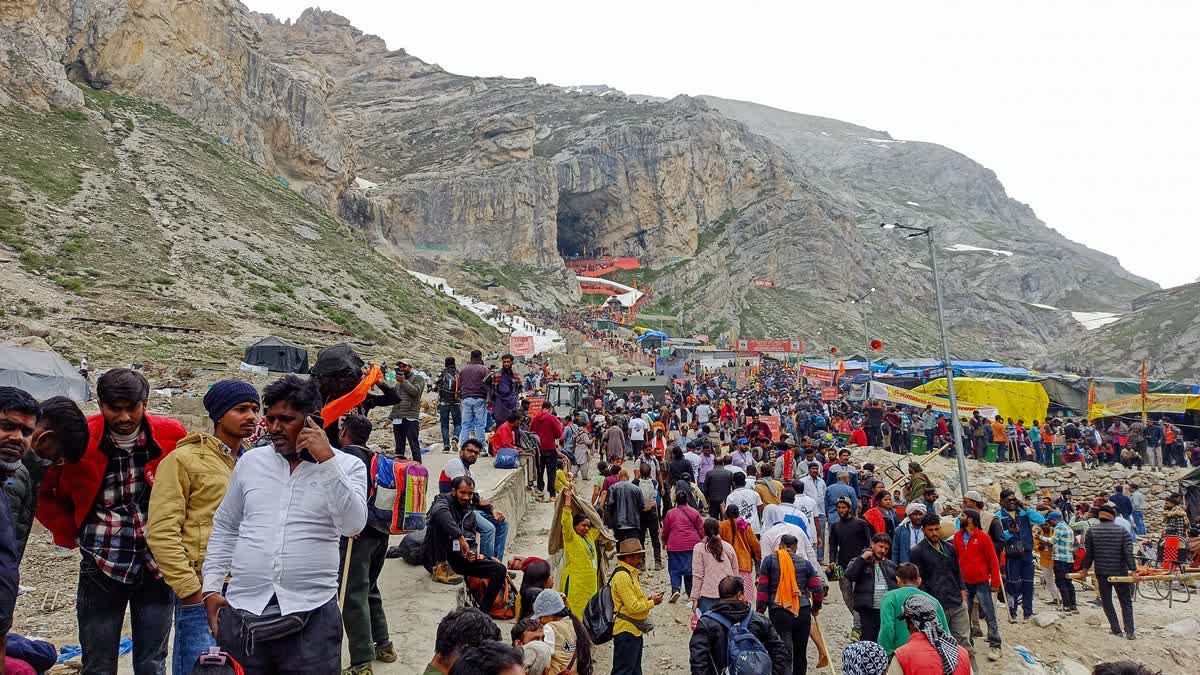
- The cave is very busy from 8am till 1pm. If you’re camping near Panjtarni, consider beginning the last leg at 5am. The wait to get into the cave itself can be 2 to 3 hours long on busy days.
Plan Now, Prepare Well, Experience More
The yatra doesn't reward shortcuts. You have six to eight weeks—use them for fitness, a medical certificate from an SASB-approved hospital, and acclimatization. Registration opens July 3rd and closes August 12th. By the time you reach Panjtarni at 3,800 meters, those weeks will make sense. Standing before the ice Shivalinga at 3,888 meters is unlike anything else you'll experience in India. But it asks you to show up prepared.
Book your tour package with Travelvichar!
